Use EasyAR Mega for object tracking
EasyAR Mega's core capability is not limited to localization across an entire physical space. It can also be applied to high-precision 3D tracking of specific, known physical objects. This lets you accurately track a preset object, such as industrial equipment, an exhibit, or a retail product, using the same development approach as Mega, and overlay rich virtual content on it.
Basic principles and workflow
The principle of Mega object tracking is similar to that of Mega large-space applications. It combines the object's own visual features with advanced cloud localization algorithms to achieve a more stable and accurate result than traditional object tracking.
Mega object tracking can be viewed as a special case of Mega spatial localization on a specific object target. Its localization process is exactly the same; the only difference is that the mapping side has slight differences for the special characteristics of objects.
The workflow is as follows:
Map construction:
- Use a smartphone with good SLAM capability and a dedicated Mega Toolbox App to collect data around the target object.
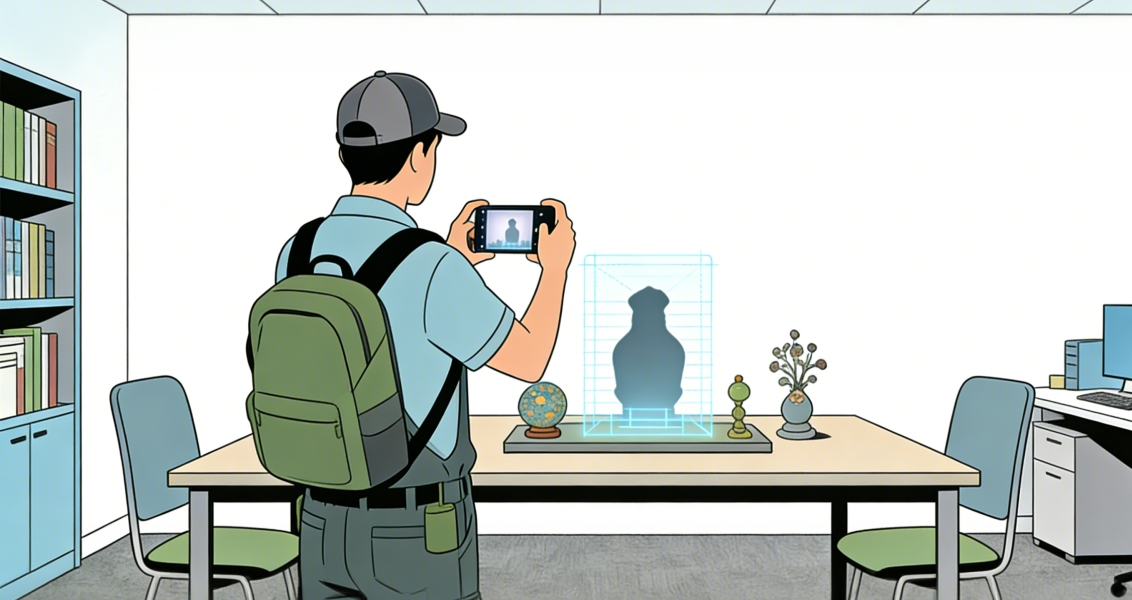
- Upload the collected *.EMP data through EasyAR's mapping management backend.
- The cloud processing platform processes the collected data, uses advanced AI algorithms to extract the visual features of the target object, generates a 3D point cloud of the target object, and builds a textured dense mesh.
- The final output of the mapping system also exists as a "Mega Block map".
- Use a smartphone with good SLAM capability and a dedicated Mega Toolbox App to collect data around the target object.
Real-time tracking:
- When the user's device scans the target object, it first uses Mega localization for real-time localization and recovers the current device pose.
- It then fuses with the device's own SLAM system on the device side, aligning the coordinate system of the Mega map with the coordinate system of the device SLAM system, thereby achieving continuous real-time tracking.
Tip
Further reading: principles of Mega spatial localization.
Differences and comparison with Mega spatial localization
Compared with Mega spatial localization, Mega object tracking is technically consistent, but the application scenarios it focuses on are different:
| Feature | Mega spatial localization | Mega object tracking |
|---|---|---|
| Core purpose | Enable user navigation in a macroscopic environment and spatial anchoring of virtual content | Enable digitization, information overlay, and virtual-real interaction for specific objects |
| Spatial computing | Localize through Mega cloud service or Mega Go and perform fused tracking on the device side | Exactly the same as Mega spatial localization |
| Application scenarios | Indoor and outdoor navigation, large-scale AR games, city-scale digital twins | Industrial equipment inspection, exhibit guidance, retail product AR try-on |
Differences and comparison with EasyAR Sense 3D object tracking
EasyAR Sense also provides a powerful 3D Object Tracking feature, but Mega object tracking differs significantly from it in design philosophy and application scenarios:
| Feature | 3D Object Tracking | Mega object tracking |
|---|---|---|
| Localization basis | Depends on a standard-format 3D model, which can come from a 3D scanner, 3D reconstruction software, etc. | Depends on a prebuilt Mega spatial map, collected by phone and generated in the cloud |
| Tracking stability | Good, but may be lost during fast movement or partial occlusion | Stronger resistance to occlusion and interference, and more stable tracking |
| Object requirements | The object itself needs rich texture and simple geometry | The object itself has lower texture richness requirements, and the geometry can be more complex |
| Environment requirements | No requirements for the environment; the target object can be in any environment | The target object's environment can be different from that during mapping collection, but the environment must not be changed arbitrarily while the feature is in use |
| Network requirement | No network required; all data and computation occur on the device side | Network on demand; full-time networking is required when using Mega cloud localization service, while data and computation occur on the device side when using Mega Go on-device localization |
| Dynamics | Supported. The target object can move in the environment while the feature is in use | Not supported. The target object must remain static while the feature is in use |
| Scalability | Can be extended to support simultaneous tracking of multiple target objects, and the target objects are independent of each other | Can track multiple objects in the same space, but these objects must remain static in the space, and the objects are not independent of each other |
| Applicable scenarios | Objects with simple structure and rich texture that need to move flexibly during the experience, such as being held and played with | Objects with complex structure and ordinary texture that are relatively fixed in space during the experience, such as factory equipment inspection or museum exhibit guidance |
How to choose:
- If your application scenario is to recognize an independent, movable object and you do not care about its position in the macroscopic environment, EasyAR Sense 3D Object Tracking is a lighter and more direct choice.
- If your application scenario is to perform high-precision, high-stability tracking and digitization of one or more fixed objects in a fixed space, such as a factory, museum, or shopping mall, EasyAR Mega object tracking is the best choice.